
How to Choose an Asparagus Optical Sorter in 2026?

Choosing an Asparagus Optical Sorter in 2026 requires more than comparing camera resolution or machine speed. Fresh asparagus varies in diameter, color, curvature, moisture, and tip condition. A suitable system must recognize these differences while protecting delicate spears from bruising. It should also match your farm’s harvest volume, labor capacity, belt layout, and cleaning routine.

Dr. Miguel Santos, an asparagus-processing engineer, says, “The best sorter is not the fastest machine; it is the one that protects quality consistently.” This practical view matters. A machine may process eight tons per hour, yet create excessive waste or miss subtle defects. Ask suppliers for test results using your own asparagus. Examine cracked tips, purple discoloration, soil marks, hollow stems, and inconsistent lengths. Watch the machine operate with wet produce, not only polished samples.

Look closely.

Reliable selection also depends on software, sensor calibration, reject accuracy, and operator training. In 2026, artificial intelligence can improve defect detection, but it does not remove the need for experienced workers. Some systems perform impressively during demonstrations and disappoint after installation. That possibility deserves attention. Request references from processors with similar varieties and seasonal conditions. Confirm spare-part availability, remote support, sanitation access, and data ownership before signing an agreement. The right Asparagus Optical Sorter should reduce manual inspection without weakening human judgment. A careful evaluation may take longer, but it can prevent expensive redesigns, unnecessary product loss, and disappointing quality claims.
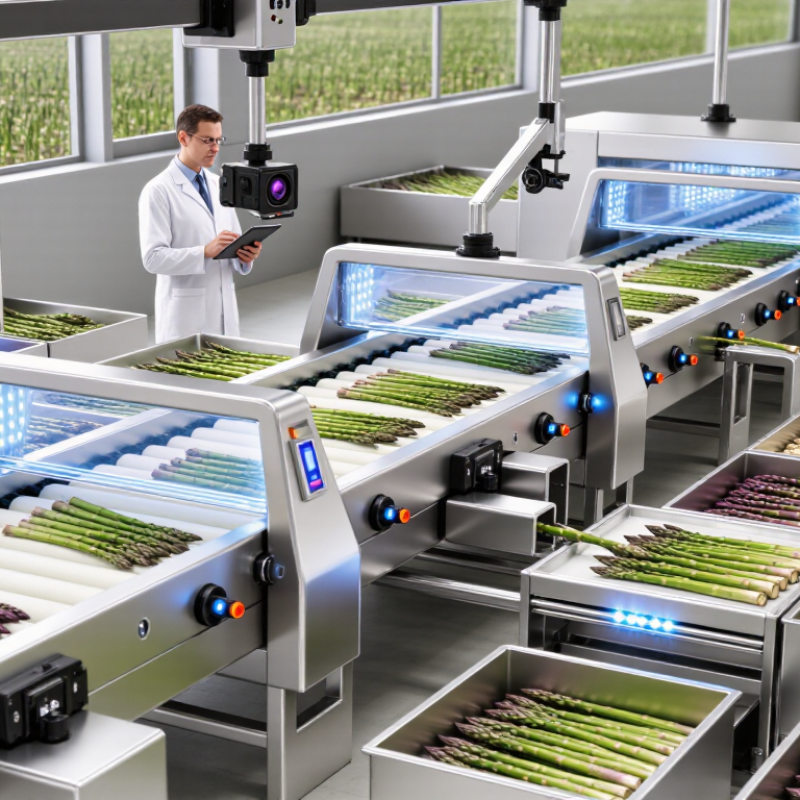
How to Choose an Asparagus Optical Sorter in 2026?

Asparagus Optical Sorters: Definition, Purpose, and Core Functions

How to Choose an Asparagus Optical Sorter in 2026?

An asparagus optical sorter uses cameras, sensors, and software to inspect spears on a moving line. It identifies differences in color, size, shape, and visible damage. Its purpose is practical: remove misshapen, bruised, woody, or discolored asparagus before packing. This protects product consistency and reduces manual inspection pressure. In real processing rooms, lighting, dust, and wet surfaces can affect accuracy. A sorter should therefore perform reliably under changing conditions, not only during demonstrations.

Core functions include image capture, defect classification, size grading, and automatic rejection. Many systems use precise air jets to separate unwanted spears without touching good produce. Adjustable settings help processors handle green, white, or purple asparagus. Data records can also reveal repeated problems, such as excessive bruising near a cutting station. Yet no sorter is perfect. Soft defects may escape detection, while unusual shapes may be rejected unnecessarily. Operators still need training, routine calibration, and careful review of rejected produce.

Tips: Test the machine with your own asparagus, including wet, thin, bent, and damaged spears. Ask for measurable accuracy results and rejection rates. Check cleaning access, sensor protection, spare-part availability, and operator controls. A simple interface matters during a busy harvest shift. Review samples manually. That step can expose errors that screen statistics hide.

How to Choose an Asparagus Optical Sorter in 2026?

Asparagus optical sorters use cameras, lighting, image processing, and air-jet rejection to identify quality differences at high speed. The chart below presents an example procurement test-plan weighting for comparing sorter capabilities without using company or brand data.

Prioritize defect detection, color and shape recognition, size grading, foreign-material removal, throughput stability, and gentle handling. Before purchase, validate these functions with representative asparagus varieties, moisture levels, defect types, line speeds, and acceptable yield-loss limits.

Key Sorting Criteria for Asparagus Quality and Defect Detection

How to Choose an Asparagus Optical Sorter in 2026?

Asparagus quality begins with defect detection, not machine speed.

The USDA Agricultural Marketing Service evaluates fresh asparagus by color, size, appearance, and damage tolerance. A suitable optical sorter should identify spears with open tips, brown discoloration, decay, bruising, cuts, and hollow stems. These defects often appear differently under warehouse lighting.

Lighting matters greatly.

Use controlled LED illumination with RGB cameras for surface color and near-infrared sensing for hidden moisture or decay signals. The FAOSTAT production database shows that asparagus is produced across diverse climates and farming systems. This creates noticeable variation in spear color, diameter, and moisture. A sorter trained only on uniform samples may reject acceptable produce.

Check detection resolution, belt stability, and reject accuracy.

A few millimeters can separate a marketable tip from a damaged one. Ask suppliers for test results using your own harvest, including wet spears and mixed sizes. The United Nations UNECE standard for asparagus also emphasizes presentation, cleanliness, soundness, and freedom from serious defects. Hygiene design is essential around cut ends and plant residue. Stainless contact surfaces help, but they do not replace cleaning discipline.

Do not judge performance by throughput alone.

False rejects reduce yield, while missed decay harms packed lots. That trade-off needs measurement. Maybe the best settings will change by season. Build a review process around defect images, rejection rates, and customer complaints.

Optical Technologies Used in Asparagus Sorting Systems

How to Choose an Asparagus Optical Sorter in 2026?

Optical Technologies Used in Asparagus Sorting Systems

Asparagus sorting now depends on more than visible color. FAOSTAT’s 2022 crop data records over 9 million tonnes of asparagus worldwide. That volume increases pressure on processors to reduce manual inspection errors and product waste. RGB line-scan cameras detect color variation, broken tips, bruising, and uneven spear shapes. NIR sensors can identify moisture differences and some internal defects that ordinary cameras miss. Hyperspectral systems provide deeper material analysis, but they usually cost more and require stronger technical support.

Lighting changes everything. Wet cut surfaces can create glare, while overlapping spears hide defects. Laser profiling helps measure diameter and crookedness, but it should not replace camera inspection. AI software can classify subtle blemishes, although poor training images may produce unstable decisions. Air-jet rejection must match belt speed precisely. A delayed jet can damage nearby spears or waste acceptable produce. The USDA’s 2023 agricultural outlook continues to emphasize quality consistency and postharvest loss control, making accurate inspection increasingly valuable. Still, no sensor sees every defect.

Tips: Request test results using your own asparagus. Measure false rejects, missed defects, throughput, and cleaning time. Ask whether the system handles mixed calibers, wet produce, and changing daylight. A factory demonstration may look perfect. Real harvest conditions are less forgiving. Calibration routines matter more than impressive camera specifications.

How to Choose an Asparagus Optical Sorter in 2026? - Optical Technologies Used in Asparagus Sorting Systems
Selection guidance is based on the physical information each optical technology can capture. Actual results depend on asparagus variety, diameter, surface moisture, line speed, product presentation, lighting design, and the quality of the sorting algorithm.
Optical Technology Typical Spectral or Measurement Range Primary Information Captured Asparagus Conditions It Can Help Identify Main Advantages Important Limitations Relative Suitability for Asparagus Sorting
RGB Area-Scan Imaging Visible light, approximately 400–700 nm Surface color, shape, contour, visible texture, and image-based dimensions Yellowing, browning, discoloration, open or damaged tips, surface blemishes, broken spears, and mixed color grades Provides intuitive color images; suitable for appearance grading; comparatively simple to integrate with controlled LED illumination Limited ability to detect hidden or internal defects; performance can be affected by shadows, condensation, dirt on the camera window, and changing illumination Very high for surface appearance
Near-Infrared Imaging Approximately 700–1,000 nm; some industrial systems extend beyond 1,000 nm Differences in reflectance related to water, organic material, and chemical composition Moisture-related variation, some bruising or tissue changes, and material differences that are difficult to separate using visible color alone Can add material-sensitive information to RGB inspection; less dependent on visible color differences Detection performance depends strongly on wavelength selection, calibration, product freshness, and defect depth; it does not automatically reveal every internal defect High when material information is required
Short-Wave Infrared Imaging Approximately 1,000–2,500 nm More detailed spectral differences associated with water and organic compounds Selected moisture variation, tissue damage, foreign material, and composition differences that may be weak in visible and near-infrared images Offers stronger material discrimination than visible imaging for some applications; useful when product composition or moisture is a key concern Higher equipment cost; requires suitable detectors, optics, and illumination; atmospheric moisture and surface condition can influence measurements High for advanced material inspection
Multispectral Imaging Several discrete bands selected from visible, near-infrared, or short-wave infrared ranges Reflectance values at predefined wavelengths Color grade, surface damage, moisture-related differences, and selected defect categories defined during system development Balances information content, processing speed, and system complexity; targeted wavelengths can be chosen for specific asparagus defects Only measures the installed wavelength bands; performance may decline when a defect is outside the selected spectral signatures Very high for targeted sorting programs
Hyperspectral Imaging Many contiguous spectral bands across a defined visible, NIR, or SWIR range A complete spectral signature for each measured pixel or product region Research or advanced production classification of subtle surface and material differences, including quality variation not reliably separated by RGB alone Provides the richest spectral dataset; supports development of new defect models and detailed quality classification More data-intensive and complex; generally requires stronger computing, calibration, model development, and process control than standard multispectral systems High for development and specialized inspection
3D Laser or Structured-Light Measurement Geometric measurement using projected light and camera triangulation; no single universal wavelength applies Height profile, diameter, curvature, shape, and three-dimensional position Abnormal curvature, misshapen spears, height differences, uneven presentation, and dimensional grading Adds shape information that 2D color cameras cannot provide; can improve product positioning and dimensional classification Does not directly identify many color or chemical defects; shiny, wet, overlapping, or rapidly moving products may reduce measurement quality High for shape and dimensional grading
Polarized Visible-Light Imaging Visible light with controlled polarization, approximately 400–700 nm Surface-reflection behavior and visible appearance with reduced glare Surface scarring, wet-surface variation, glare-obscured blemishes, and some texture differences Can reduce specular reflection from wet or smooth asparagus surfaces; improves image consistency in selected applications Usually complements RGB imaging rather than replacing it; polarization cannot compensate for poor product separation or insufficient illumination Medium to high as an RGB enhancement
Fluorescence Imaging Excitation commonly uses ultraviolet or blue light; emitted response is measured at longer wavelengths Fluorescence response from selected surface compounds or contamination indicators Specific surface contamination or biological-surface indicators when a validated fluorescence signature exists Can reveal certain surface conditions that are difficult to distinguish under ordinary white light Requires application-specific validation; not a general-purpose replacement for RGB, NIR, or SWIR sorting Specialized and application-dependent
Combined RGB + NIR or Multispectral System Two or more coordinated spectral ranges, commonly visible plus NIR or SWIR bands Surface appearance together with material-sensitive reflectance information Color defects, surface damage, moisture-related variation, foreign material, and selected quality classes Combines complementary information and can reduce dependence on a single visual feature; often a practical choice for demanding commercial sorting Higher integration, calibration, software, and maintenance requirements than a single-camera system Very high for multi-defect inspection
Air-Jet Ejection with Optical Detection Not a sensing spectrum; pneumatic separation is triggered by optical classification Fast physical removal of classified products from the product stream Removal of defective, discolored, undersized, oversized, foreign, or incorrectly graded spears after optical detection Non-contact separation; suitable for high-speed handling when air pressure, nozzle timing, and product spacing are correctly controlled Requires accurate timing and stable compressed air; overlapping products can reduce ejection precision; excessive air can damage delicate products or disturb neighboring spears Essential for many continuous sorting lines
Practical selection rule: Choose RGB imaging for visible appearance and color grading, add NIR or SWIR when material or moisture information is important, consider 3D measurement for shape and dimensional grading, and use multispectral or hyperspectral sensing only when the additional information justifies the calibration and data-processing requirements.

How to Compare Capacity, Accuracy, and Product Handling

How to Choose an Asparagus Optical Sorter in 2026?

Capacity, accuracy, and product handling should guide your decision. A machine must match your real harvest flow, not an impressive brochure figure. Measure peak hourly volume, asparagus length, diameter, and moisture variation. A sorter running too slowly creates queues. One running too fast may reduce detection accuracy.

Tips: Test with your own asparagus batches. Include thin spears, bent pieces, broken tips, and damp surfaces. Ask for verified results under similar conditions. A laboratory sample can mislead. Small details matter.

Accuracy depends on camera resolution, lighting stability, software settings, and reject timing. Request data for both false rejects and missed defects. A high accuracy percentage means little without clear test conditions. In my experience, operators also need simple controls and quick cleaning access. Product handling deserves equal attention. Gentle belts, controlled transfers, and soft contact points can reduce bruising and tip damage. Check whether the machine handles mixed sizes without constant manual adjustment. Capacity claims often assume ideal feeding. That is not always realistic. Leave practical headroom for uneven supply and maintenance pauses. Ask to observe a live trial, then inspect rejected asparagus by hand. You may discover that a technically accurate sorter still wastes valuable product.

Installation, Maintenance, and Cost Factors in 2026

How to Choose an Asparagus Optical Sorter in 2026?
Installation, Maintenance, and Cost Factors in 2026

Installation conditions often decide whether an optical sorter performs reliably. Measure line speed, product width, moisture, and available floor space before ordering. Leave access around inspection cameras and ejector valves. Technicians need room to clean lenses without stopping the entire packing line. Stable electricity and controlled compressed air are essential. Poor lighting can also reduce detection accuracy.

Maintenance should fit the farm’s real working rhythm. Remove asparagus fragments from belts, air nozzles, and reject channels every shift. Clean camera covers with approved materials, not rough cloth. Check calibration after major temperature changes or belt replacement. Keep spare seals, filters, and solenoid components on site. Small faults become expensive during peak harvest. Remote support helps, but it cannot replace trained local operators.

Purchase price is only one part of the 2026 cost calculation. Include installation labor, conveyor changes, software updates, energy use, training, and annual servicing. A cheaper machine may require more manual rechecking. That hidden labor can erase the initial saving. Compare cost per usable ton, not only the equipment invoice. I would request a trial using your own asparagus, because sample quality varies sharply by season. The first estimate is often wrong. Recheck it after one harvest.