
Why Buy a Used Communication Tester?
A Used Communication Tester can make advanced RF and network measurements more affordable, especially for teams upgrading a lab or supporting legacy equipment. The right unit may help verify signal quality, frequency response, modulation, and receiver performance without the cost of a new instrument. But a low price alone proves very little.
“Buy verified capability, not just a familiar model number.” This is a practical editorial principle, not a quotation attributed to a named expert. No source was provided to verify an industry specialist’s name or exact words, so assigning this line to a person would be misleading. Buyers should check the tester’s frequency range, supported standards, firmware, connector condition, calibration records, and included accessories. A scratched case may be harmless. A worn RF connector or missing license may not be.
Ask for a demonstration using a known signal source. Confirm that readings are stable, controls respond correctly, and the serial number matches the documentation. Also check whether calibration or repairs remain available. Small details matter. A missing cable can delay a project; outdated software can limit useful measurements. Used equipment can offer real value, but the trade-off deserves scrutiny. Even a well-maintained tester may not fit every workflow, and that possibility is easy to overlook when the discount looks compelling.
What a Communication Tester Measures
Why Buy a Used Communication Tester?
What a Communication Tester Measures
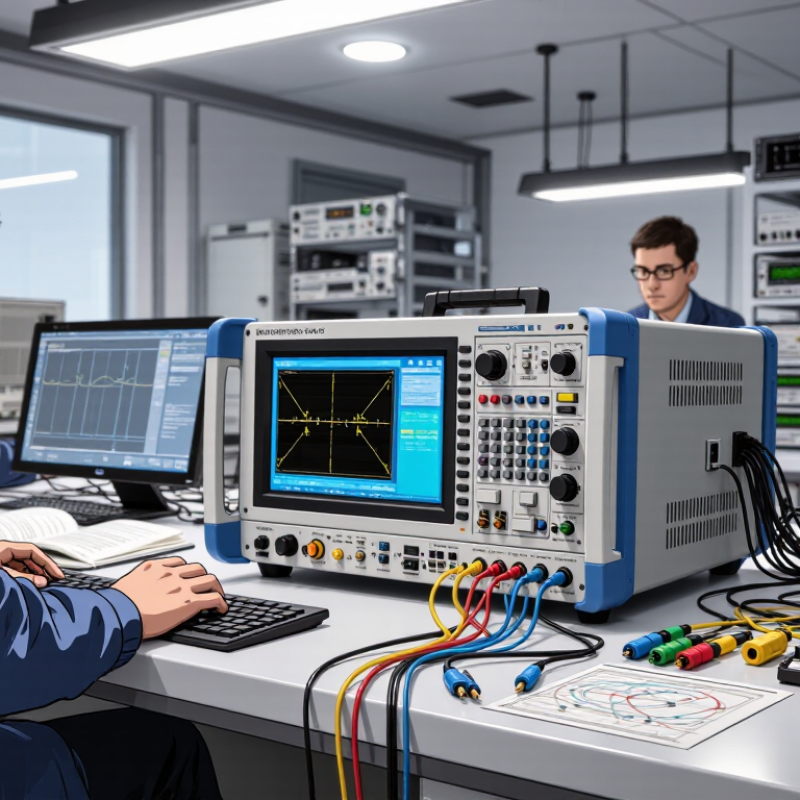
A communication tester turns an invisible signal into readings you can inspect. Depending on its functions, it may measure frequency, signal power, modulation quality, and transmission errors. On a bench, a technician might connect a radio, watch the frequency drift, then compare output power against the service specification. Small changes matter. A weak signal can cause dropped audio or unstable data, even when a device appears to work.
For digital links, some testers report bit-error rate, timing, and channel performance. For RF systems, spectrum views can reveal unwanted peaks or interference near the intended channel. Cable and antenna checks may show return loss or insertion loss, helping locate a damaged connector or a long, lossy run. Readings depend on setup, adapters, test limits, and the device under test. A clean screen is not proof of a perfect network.
Buying used can make capable measurement tools more accessible, but verify the basics before relying on one. Check calibration status, included leads, battery condition, and whether its frequency range and protocols match your work. Ask for a recent self-test or sample measurement. Old accessories can skew results. I would also compare one reading with a known-good instrument when possible. That matters. It is an easy step to skip, and worth reconsidering. A tester is useful only when its measurements are trustworthy.
Why Buy a Used Communication Tester? - What a Communication Tester Measures
| Measurement Area | What It Measures | Common Units or Indicators | Why It Matters | What to Check When Buying Used |
|---|---|---|---|---|
| RF frequency | The frequency of a transmitted or received radio signal. | Hz, kHz, MHz, or GHz; frequency error may be shown in Hz or ppm. | Helps verify that a radio operates on its assigned channel and within its specified frequency tolerance. | Confirm the instrument covers the frequency range required for your radios, and check its calibration status and reference oscillator operation. |
| RF power | The power level of a radio-frequency signal, measured at the tester input or output. | W, mW, dBm, or dBµV, depending on the measurement and instrument. | Shows whether a transmitter is producing an appropriate signal level and can help identify output-stage or connection problems. | Inspect RF connectors and attenuator settings. Verify that the power range, measurement method, and any required external sensor are suitable for the application. |
| Modulation quality | How accurately a signal carries information using a modulation method such as AM, FM, or digital modulation. | Examples include deviation in kHz, modulation depth in percent, and error measurements such as EVM in percent. | Incorrect modulation can reduce communication quality, cause interference, or prevent a receiver from decoding a signal reliably. | Check that the tester supports the relevant modulation types and options. Test available inputs, outputs, and analysis functions with a known signal. |
| Spectrum and unwanted emissions | Signal energy across a range of frequencies, including the desired carrier, harmonics, and spurious components. | Frequency in Hz and amplitude commonly in dBm or dBµV; results may be displayed as a spectrum trace. | Helps identify interference, excessive out-of-band energy, and other transmission issues. | Check the specified frequency span, amplitude range, resolution settings, display condition, and whether the necessary measurement functions are enabled. |
| Receiver sensitivity | The lowest input signal level at which a receiver meets a defined performance criterion. | Typically dBm, evaluated alongside a stated criterion such as bit error rate or audio quality. | Indicates how well a receiver can detect weak signals. Results depend on the test method and acceptance threshold. | Confirm that the tester can generate the required signal and measure the applicable performance criterion. Review calibration records and signal-generator stability. |
| Bit error rate (BER) | The proportion of received bits that are incorrect during a digital transmission test. | Ratio or percentage, often reported with the number of tested bits. | Provides a direct indication of digital link performance under the tested conditions. | Verify support for the required digital format and test pattern. Check that the counter, synchronization, and relevant software functions operate correctly. |
| Audio performance | Audio characteristics of a radio path, which may include audio level, frequency response, distortion, or signal-to-noise ratio. | Level in V or dB; frequency in Hz; distortion and signal-to-noise ratio in percent or dB. | Helps assess intelligibility and identify problems in a radio’s microphone, transmitter, receiver, or audio circuitry. | Test audio connectors and controls, and confirm the instrument supports the audio measurements and frequency range your service work requires. |
| Return loss and cable checks | On compatible instruments, evaluates reflected RF energy or checks transmission paths such as cables and antennas. | Return loss in dB; cable faults may be reported by distance or displayed against frequency. | Reflections and damaged connections can reduce power transfer and impair radio performance. | These functions are not included on every communication tester. Confirm the feature set and inspect any required test ports, adapters, and accessories. |